


XSIAM-Analyst Dumps PDF - XSIAM-Analyst Real Exam Questions Answers
Get Started: XSIAM-Analyst Exam [2026] Dumps Palo Alto Networks PDF Questions
Palo Alto Networks XSIAM-Analyst Exam Syllabus Topics:
| Topic | Details |
|---|---|
| Topic 1 |
|
| Topic 2 |
|
| Topic 3 |
|
NEW QUESTION # 16
A threat hunter discovers a true negative event from a zero-day exploit that is using privilege escalation to launch "Malware.pdf.exe." Which XQL query will always show the correct user context used to launch "Malware.pdf.exe"?
config case_sensitive = false | dataset = xdr_data | filter event_type =
- A. ENUM.PROCESS | filter action_process_image_name = "Malware.pdf.exe" |
fields causality_actor_effective_username
config case_sensitive = false | dataset = xdr_data | filter event_type = - B. ENUM.PROCESS | filter action_process_image_name = "Malware.pdf.exe" |
fields action_process_username
config case_sensitive = false | datamodel dataset = xdr_data | filter - C. xdm.source.process.name = "Malware.pdf.exe" | fields
xdm.target.user.username
config case_sensitive = false | dataset = xdr_data | filter event_type = - D. ENUM.PROCESS | filter action_process_image "Malware.pdf.exe" | fields
actor_process_username
Answer: A
Explanation:
causality_actor_effective_usernamerecords the effective user after privilege changes, ensuring the query returns the actual user context that launched the process even when privilege escalation occurs.
NEW QUESTION # 17
Match each alert evidence type with its investigation value:
Alert Evidence
A) Timeline
B) ITDR Findings
C) Causality Chain
D) File Hash
Use in Investigation
1. Tracks sequence of events
2. Indicates identity misuse
3. Shows parent-child process lineage
4. Maps to known malware indicators
Response:
- A. A-1, B-2, C-3, D-4
- B. A-4, B-2, C-3, D-1
- C. A-1, B-3, C-2, D-4
- D. A-1, B-2, C-4, D-3
Answer: A
NEW QUESTION # 18
Which type of analytics will trigger the alert on the image shown?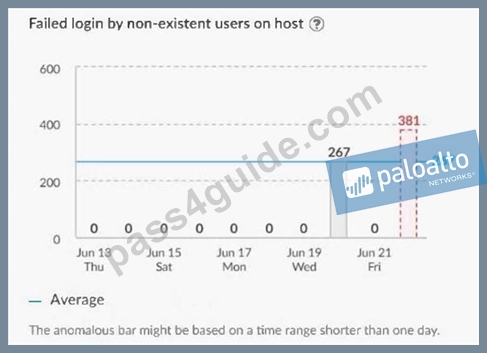
- A. Contextual
- B. Baseline
- C. Anomaly
- D. Behavioral
Answer: C
Explanation:
The chart shows a learned average (baseline) and a spike far above it; this deviation from normal behavior is what the Anomaly analytics detector flags.
NEW QUESTION # 19
Which type of alert in Cortex XSIAM is primarily based on endpoint telemetry and behavior?
- A. XDR Agent
- B. BIOC
- C. IOC
- D. Correlation
Answer: B
NEW QUESTION # 20
Which interval is the duration of time before an analytics detector can raise an alert?
- A. Deduplication period
- B. Activation period
- C. Test period
- D. Training period
Answer: B
Explanation:
The activation period is the built-in wait time after a detector is enabled during which it gathers baseline data; only after this interval can the detector begin raising alerts.
NEW QUESTION # 21
A security analyst is reviewing alerts and incidents associated with internal vulnerability scanning performed by the security operations team.
Which built-in incident domain will be assigned to these alerts and incidents in Cortex XSIAM?
- A. Health
- B. IT
- C. Hunting
- D. Security
Answer: B
Explanation:
Alerts from routine internal vulnerability scanning are operational/maintenance activity, so Cortex XSIAM assigns them to the built-in IT incident domain rather than Security or Hunting.
NEW QUESTION # 22
What is the cause when alerts generated by a correlation rule are not creating an incident?
- A. The rule does not have a drill-down query configured.
- B. The rule is configured with alert severity below Medium.
- C. The rule is using the preconfigured Cortex XSIAM alert field mapping.
- D. The rule has alert suppression enabled.
Answer: B
NEW QUESTION # 23
A security analyst has been assigned a ticket from the help desk stating that users are experiencing errors when attempting to open files on a specific network share. These errors state that the file format cannot be opened. IT has verified that the file server is online and functioning, but that all files have unusual extensions attached to them.
The security analyst reviews alerts within Cortex XSIAM and identifies malicious activity related to a possible ransomware attack on the file server. This incident is then escalated to the incident response team for further investigation.
Upon reviewing the incident, the responders confirm that ransomware was successfully executed on the file server. Other details of the attack are noted below:
- An unpatched vulnerability on an externally facing web server was
exploited for initial access
- The attackers successfully used Mimikatz to dump sensitive
credentials that were used for privilege escalation
- PowerShell was used on a Windows server for additional discovery, as
well as lateral movement to other systems
- The attackers executed SystemBC RAT on multiple systems to maintain
remote access
- Ransomware payload was downloaded on the file server via an external
site, "file.io"
Refer to the scenario to answer this question:
Which hunt collection category in Cortex XSIAM should the incident responders use to identify all systems where the attackers established persistence during the attack?
- A. Process Execution
- B. Command History
- C. Network Data
- D. Remote Access
Answer: D
Explanation:
The Remote Access hunt collection surfaces tools and mechanisms (RATs, backdoors, remote services) attackers use to maintain persistence. Querying it will reveal where SystemBC or similar access channels were established across systems.
NEW QUESTION # 24
Which Cortex XSIAM feature allows managing multiple indicators and applying verdicts manually?
Response:
- A. Asset Inventory
- B. Automation Editor
- C. Indicator Management Console
- D. Live Terminal
Answer: C
NEW QUESTION # 25
An alert for malware propagation triggers an incident. The associated playbook isolates the endpoint and notifies the SOC team. What advantages does this approach provide? (Choose two)
- A. Allows unrestricted user activity
- B. Reduces mean time to respond (MTTR)
- C. Automates critical response actions
- D. Prevents SOC teams from seeing alert metadata
Answer: B,C
NEW QUESTION # 26
During an ongoing investigation, a user reports a suspected file on their machine. What actions can the analyst take using XSIAM?
(Choose two)
Response:
- A. Push a browser update
- B. Delete the file via DNS filter
- C. Retrieve the file using endpoint file retrieval
- D. Perform malware scan
Answer: C,D
NEW QUESTION # 27
An incident context tab shows:
- User = jsmith@corp
- Affected endpoints = 2
- Alerts = file modification, process injection
What can be concluded?
Response:
- A. This is likely an HR system error
- B. The same user was involved across multiple assets
- C. The incident links multiple alerts and assets to the same identity
- D. Alerts are isolated and unrelated
Answer: B,C
NEW QUESTION # 28
SCENARIO:
A security analyst has been assigned a ticket from the help desk stating that users are experiencing errors when attempting to open files on a specific network share. These errors state that the file format cannot be opened. IT has verified that the file server is online and functioning, but that all files have unusual extensions attached to them.
The security analyst reviews alerts within Cortex XSIAM and identifies malicious activity related to a possible ransomware attack on the file server. This incident is then escalated to the incident response team for further investigation.
Upon reviewing the incident, the responders confirm that ransomware was successfully executed on the file server. Other details of the attack are noted below:
* An unpatched vulnerability on an externally facing web server was exploited for initial access
* The attackers successfully used Mimikatz to dump sensitive credentials that were used for privilege escalation
* PowerShell was used on a Windows server for additional discovery, as well as lateral movement to other systems
* The attackers executed SystemBC RAT on multiple systems to maintain remote access
* Ransomware payload was downloaded on the file server via an external site "file io" QUESTION STATEMENT:
Which hunt collection category in Cortex XSIAM should the incident responders use to identify all systems where the attackers established persistence during the attack?
- A. Process Execution
- B. Command History
- C. Network Data
- D. Remote Access
Answer: D
Explanation:
The correct answer isA - Remote Access.
TheRemote Accesshunt collection category in Cortex XSIAM is specifically designed to help incident responders identify endpoints where attackers have installed remote access tools (RATs) or backdoors, which are classic methods of attacker persistence. In this scenario, the attackers executedSystemBC RATon multiple systems to maintain remote access, making the "Remote Access" category the most relevant for finding all endpoints where persistence was established.
"Remote Access hunt collections in Cortex XSIAM identify the presence of remote access tools such as RATs and backdoors used by attackers to maintain persistence on endpoints. Analysts should review this collection category after incidents involving tools like SystemBC RAT." Document Reference:XSIAM Analyst ILT Lab Guide.pdf, Page 28 (Alerting and Detection / Threat Intel Management sections)
NEW QUESTION # 29
How would Incident Context be referenced in an alert War Room task or alert playbook task?
- A. ${parentIncidentFields}
- B. ${getparentIncidentFields}
- C. ${getParentIncidentContext}
- D. ${parentIncidentContext}
Answer: D
Explanation:
The correct answer isA - ${parentIncidentContext}.
This syntax is the correct variable for referencing the incident context within playbook and War Room tasks, enabling data to be accessed from the parent incident during alert investigation or automation steps.
"Use ${parentIncidentContext} in War Room and playbook tasks to reference the context of the parent incident." Document Reference:EDU-270c-10-lab-guide_02.docx (1).pdf Page:Page 39 (Incident Handling and Playbook Automation section)
NEW QUESTION # 30
A Cortex XSIAM analyst is investigating a security incident involving a workstation after having deployed a Cortex XDR agent for 45 days. The incident details include the Cortex XDR Analytics Alert "Uncommon remote scheduled task creation." Which response will mitigate the threat?
- A. Initiate the endpoint isolate action to contain the threat.
- B. Revoke user access and conduct a user audit
- C. Prioritize blocking the source IP address to prevent further login attempts.
- D. Allow list the processes to reduce alert noise.
Answer: A
Explanation:
The correct answer isA - Initiate the endpoint isolate action to contain the threat.
For incidents indicating possible remote compromise or unauthorized task creation, the most effective initial response isendpoint isolation. This cuts off the endpoint's network access, preventing lateral movement and limiting attacker activity until further investigation and remediation.
"The endpoint isolate action is the primary containment step in incidents involving suspected remote compromise, halting network communication to reduce further risk." Document Reference:XSIAM Analyst ILT Lab Guide.pdf Page:Page 40 (Incident Handling/SOC section)
NEW QUESTION # 31
......
XSIAM-Analyst Premium Exam Engine pdf Download: https://torrentvce.pass4guide.com/XSIAM-Analyst-dumps-questions.html