


Pass Guaranteed Quiz 2022 Realistic Verified Free ASD01 Exam Dumps
Free Blue Prism Solution Designer ASD01 Ultimate Study Guide (Updated 30 Questions)
Blue Prism ASD01 Exam Syllabus Topics:
| Topic | Details |
|---|---|
| Topic 1 |
|
| Topic 2 |
|
| Topic 3 |
|
| Topic 4 |
|
NEW QUESTION 18
ProSafe credit reference agency retrieves data from bank and other credit providers where customers have missed payments or gone into default. The data is very sensitive and fed directly into a Blue Prism work queue via a web service. Blue Prism process must process the data within 4 hours. The Blue Prism solution runs continuously and each case takes approximately 30 seconds to process. It is expected that an average of 10,000 cases per day will be required and up to 10 Blue Prism robots are available. The Blue Prism solution is sown below:
For each case of the process will access the customer account in the HotRisk system and, where an account exists, harvest the data which will be fed along with the Work Queue data into a rules engine. The rules engine is a Blue Prism process that does not interact with any target system. It merely consumes data and, via a complicated series of decision and choice stages, determines the new customer risk factor.
There is to be no scheduler used. Instead the Process Controllers who work in shifts to provide 24 hour support will stop and start process instances in line with Work Queue volumes.
As a Blue Prism process solution designer, who is reviewing the solution, which of the following would concern you? (Choose three.)
- A. The solution is not scalable.
- B. The data is too sensitive for automated processing.
- C. The process does not have an end stage.
- D. The process opens and closes the HotRisk system for each case.
- E. There is no scheduler.
- F. The rules engine has been built in a process not an object.
Answer: A,D,E
NEW QUESTION 19
Consider the following high-level design. The solution is intended to read medical data from one application in order to update another An input file is prepared by an overnight batch run for the solution to work through each morning before patients arrive. Usually the input file is fairly small but at certain times each month the file is much larger.
Which of these options should be considered by the process solution designer to guarantee the quality of the end-to-end solution? (select 4 responses)
- A. The solution should use an environment lock to ensure the file can only be accessed by one Resource PC at a time.
- B. The file should be updated at the start of each case to prevent other RPCs from working it.
- C. Each Resource PC should be set to take a different row from the others, e, g. RPC-A works rows t, 4, 7,
10 etc., RPC-B works 2, 5. 8 etc and RPC-C works 3, b, 9 etc. - D. Once in production the process controller should ensure that the process is only ever run on one Resource PC
- E. The solution should split the file into pieces to distribute to each Resource PC.
- F. The solution should log out from applications after exiting working loop.
- G. The batch run should create multiple input files so that each Resource PC has its own file to work with
- H. Once in production the clinic should wait until the solution has completed before admitting patients
- I. The file should be updated after each case to indicate that the case has been worked.
- J. The solution should start by loading the file data into a work queue.
- K. The solution should log in to the applications before starting the case working loop
Answer: A,B,J,K
NEW QUESTION 20
Which of the following accurately describes best practice when work is sourced from an application's workflow system?
- A. Even though there is a workflow system managing and allocating work, a Blue Prism Work Queue should still be used
- B. When sourcing work from an applications workflow system, case data should be stored in an excel document
- C. There is no need to use a Blue Prism queue as workflow is managed within the application
- D. Blue Prism cannot source work from an application's workflow system
Answer: C
NEW QUESTION 21
ProSafe credil reference agency retrieves data from bank and other credit providers where customers have missed payments or gone into default. The data is very sensitive and fed directly into a Blue Prism work queue via a web service. Blue Prism process must process the data within 4 hours. The Blue Prism solution runs continuously and each case takes approximately 30 seconds to process. It is expected that an average of 10,000 cases per day will be required and up to 10 Blue Prism robots are available. The Blue Prism solution is shown below:
For each case the process will access the customer account in the HotRisk system and, where an account exists, harvest the data which will be fed along with the Work Queue data into a rules engine. The rules engine is a Blue Prism process that does not interact with any target system. It merely consumes data and. via a complicated series of decision and choice stages, determines the new customer risk factor.
There is to be no scheduler used. Instead the Process Controllers who work in shifts to provide 24 hour support will stop and start process instances in line with Work Queue volumes.
As a Blue Prism process solution designer, who is reviewing the solution, which of the following would concern you? (select 3 responses)
- A. The solution is not scalable.
- B. The data is too sensitive for automated processing.
- C. The process does not have an end stage
- D. There is no scheduler.
- E. The process opens and closes the HotRisk system for each case
- F. The rules engine has been built in a process not an object.
Answer: A,C,D
NEW QUESTION 22
Pacific West Banking has a payments process that automatically receives pending payments from multiple regions into their payment system (Paytex).
Paytex contains a queue of cases awaiting payment. When processing the case manually an agent must use two other systems, the core banking system (DataPlus) and online account checker (FireWire).
The manual processing must perform the following steps:
* Open the next case where the status is null in Paytex
* Set the status to "In Progress" in Paytex
* Validate source account in DataPlus
* Confirm source funds in DataPlus
* Check for fraud flags in Paytex
* Confirm recipient IBAN details in Firewire
* Perform payment in Paytex
* Update case in Paytex queue. Add payment confirmation number to case and set status to "Completed"
* Where cases cannot be fulfilled due to validation errors (e.g. invalid account details, insufficient funds, suspected fraud etc.) the customers will be contacted by the agent to resolve.
A proposed Blue Prism solution with the following properties has been created to automate the payment processing:
* There will be one Blue Prism process that will perform the steps described above.
* Where a case is an exception the status will be set in Paytex to "Manual Review" in order that the manual team can pick up the case from Paytex and contact the customer and conclude the case.
* It is anticipated that to meet the SLAs of the expected volumes up to 5 instances of the Blue Prism process will be required to run concurrently.
* A Blue Prism work queue will be used to host the payments. The queue will be configured for only 1 attempt per case and the key will be (region) & {source account number}.
* The process will be started by the scheduler at 06:00 and will stop at 05:50.

Which of the following are correct? (Choose three.)
- A. The process should not be automated as it uses a third party web application.
- B. The process will not scale i.e. you cannot run multiple instances at the same time.
- C. There is a risk that a payment can be orphaned.
- D. The process should not be designed to use a Blue Prism Work Queue but use Paytex as the work queue.
- E. The solution exposes sensitive personal information.
- F. There is a risk that a payment can be duplicated.
Answer: B,D,E
NEW QUESTION 23
MedBank have recently introduced a new Credit Card platform Cred+ There is a requirement to migrate account and card details from the existing banking platform PCBS on to Cred+- Account IDs of the cases requiring data transfer will be held on a SQL database The requirement is that, for each account ID specified on the SQL database, the following data must be read from the PCBS application and input into the Cred+ application:
* Account ID
* Product Type
* Name
* Address
* Date of Birth
* Card PAN (Primary Account Number or credit card number)
* Card Issue Date
* Card Expiry Date
Once the data has been successfully input into Cred+ the correct record on the SQL database will be updated to indicate data transfer is complete. All work queues will be encrypted, however due to the sensitivity of the data. MedBank insist that a single robot account does not have access to both PCBS and CRED+ systems. The following high level design has been proposed: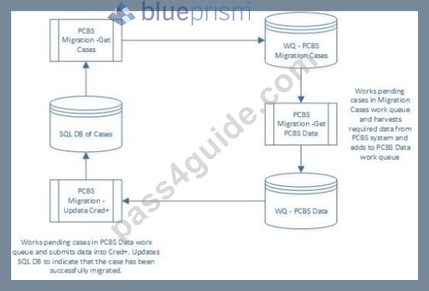
Which of the following statements about the solution design are correct? (select 2 responses)
- A. If the PCBS application suffers an outage, all Blue Prism processes specified in this design must stop processing immediately
- B. The process Get PCBS Data should be stopped if the Cred+ application suffers an outage to prevent a backlog of cases in the PCBS Data work queue.
- C. Such sensitive data should not be stored in a Blue Prism work queue
- D. The solution enables multiple instances of the Get PCBS Data and Update Cred+ processes to run without risk of collision.
- E. To reduce the elapsed time of the end to end process, the Get Cases process should be run across multiple machines.
- F. There is a risk that the outcome of a data transfer will not be recorded in the SQL database.
Answer: D,E
NEW QUESTION 24
Consider the following steps for a theoretical manual process
* Check in input folder for any new files.
* If there are no files check again later as files can arrive anytime, and there is no limit to the number of files that may come.
* Open the next available file.
* Take the first case
* Start System X and find the case details.
* If the case can't be found., move to the next one.
* After finding the case in System X. fetch additional case details from System Y.
* Again if the case can't be found, move to the next one.
* Analyse all the data to see if System Z should be updated
* If the data does not meet the requirements, add notes indicating this to Systems X and Y and move to the next case
* If the data does meet the requirements, update the case in System Z
* Add notes to Systems X and Y and move to the next case.
* At the end of the file, go back and look for another
* Stop checking for new files at 16:00 and finish any remaining cases.
* When all work is complete create a report of the day's exception cases.
* Close down Systems X, Y and Z.
If it is possible that there are long intervals between files arriving, what are the alternatives the process should take to control System X, System Y and System Z? (select 2 responses)
- A. Nothing, just leave them logged in until more work arrives
- B. Minimise them to keep the desktop clear.
- C. Close Y and Z down but keep X open because it is the first application needed to work a case.
- D. Stop them from timing out by keeping them active while waiting for files.
- E. Nothing because they will not have been started if no files have arrived yet.
- F. Log out while waiting and log back in when a file arrives.
Answer: C,F
NEW QUESTION 25
Which of the following statements about using Work Queue designs to split a business process into a multi part robotic solution is correct?
1. Using multiple Work Queues and Processes for the different stages of the business process is a valid design option to split a business process into a multi part robotic solution.
2. Using a single Work Queue and deferring cases for future processing is a valid design option to split a business process into a multi part robotic solution.
3. Using an item's status to control when to work it is a valid design option to split a business process into a multi part robotic solution.
4. You cannot split a business process into a multi part robotic solution.
- A. 1 and 2 Only
- B. 1, 2 and 3
- C. 1 and 3
- D. 4 only
Answer: C
Explanation:
Explanation/Reference:
NEW QUESTION 26
The status of a Work Queue can be used as a method of recording what work has been done so far on a Work Queue item Please consider the following statements:
1. For Ml, to easily see how far an item has been worked
2 To aid manual working of exceptions, providing the Item Status can inform staff what work is still outstanding on an item that needs manually completing
3. To enable Work Queue items to be safely retried, a process can use the item status to know which updates have already been performed so that they are not repeated
4 To record the Customer's Surname
Which of the statements are valid reasons for updating a case status?
- A. 1, 2 and 3
- B. 2 only
- C. 2 and 3 only
- D. 1 ,2, 3 and 4
Answer: A
NEW QUESTION 27
Consider the following steps for a theoretical manual process.
* Check in input folder any new files.
* If there are no files check again later as files can arrive anytime, and there is no limit to the number of files that may come.
* Open the next available file.
* Take the first case.
* Start System X and find the case details.
* If the case can't be found, move to the next one.
* After finding the case in System X, fetch additional case details from System Y.
* Again if the case can't be found, move to the next one.
* Analyse all the data to see if System Z should be updated.
* If the data does not meet the requirements, add notes indicating this to System X and Y and move to the next case.
* If the data does meet the requirements, update the case in System Z.
* Add notes to System X and Y and move to the next case.
* At the end of the file, go back and look for another.
* Stop checking for new files at 16:00 and finish any remaining cases.
* When all work is complete create a report of the day's exception cases.
* Close down Systems X, Y and Z.
If the volume of incoming cases is such that 1 Resource PC can easily handle the workload, which of the following steps for an automated solution should be part of the 'Preparation' phase of an automated process?
- A. Check input folder, wait for files, read file and load queue, log into applications.
- B. Check input folder, wait for files, read file and load queue.
- C. Log into applications.
- D. Check input folder, wait for files.
Answer: C
NEW QUESTION 28
Imagine a DR scenario where the main Production database goes down one afternoon. All processes use work queues and all new work is loaded first thing each morning. The database is backed up regularly but not in real time, so the restored back up will be slightly out of date, say by 1 hour.
If the backup was restored, and processes were restarted what would be the effect? (Choose two.)
- A. The work queue would automatically ensure no cases is duplicated.
- B. The queue item being worked at the time of the incident would need to be manually marked as an exception.
- C. The queue item being worked at the time of the incident would be automatically marked as an exception.
- D. The processes would resume with the queue item being worked at the time of the incident.
- E. The processes would resume with the next available queue item.
Answer: C,E
NEW QUESTION 29
A process is required for a telecoms company to work cases supplied via a daily Excel file Although the file will only contain around 1000 rows, the average case time is such that the workload is far too big for one machine to complete in a day, so the solution has been designed with multiple machines in mind. One machine will load the work queue while the others wait, then once the queue is ready all machines will work it together.
The requirements state that the input file is machine generated, has a known format is generally clean but may contain exceptions - rows with an empty cell, partial phone numbers, or accounts that don't exist. What should the solution do to combat this problem?
- A. The solution should apply a filter to the Excel file to hide any row with empty cells and only load the complete rows.
- B. The solution should validate the data and check that the accounts exist in the target applications beforehand, so that only clean cases are loaded into the queue.
- C. The solution should open the file and delete any row with either missing, incomplete or invalid data.
Then the clean' file should be read and the resulting collection added to the queue. - D. The solution should read the file and load the queue without validating the data The data validation should be the first step in working a queue item, with invalid cases marked as exceptions.
- E. The solution should read the file and then loop through the resulting collection and discard any row with either missing, incomplete or invalid data. Then the 'clean' collection should then be loaded into the queue
Answer: E
NEW QUESTION 30
Which of the following statements about using Work Queue designs to split a business process into a multi part robotic solution is correct?
1. Using multiple Work Queues and Processes for the different stages of the business process is a valid design option to split a business process into a multi part robotic solution.
2. Using a single Work Queue and deferring cases for future processing is a valid design option to split a business process into a multi part robotic solution.
3. Using an item's status to control when to work it is a valid design option to split a business process into a multi part robotic solution.
4. You cannot split a business process into a multi part robotic solution.
- A. 1 and 2 Only
- B. 1, 2 and 3
- C. 1 and 3
- D. 4 only
Answer: C
NEW QUESTION 31
A proposed Blue Prism solution with the following properties has been created to automate the payment processing:
* There will be one Blue Prism process that will perform the steps described above.
* Where a case is an exception the status will be set in Paytex to "Manual Review" in order that the manual team can pick up the case from Paytex and contact the customer and conclude the case.
* It is anticipated that to meet the SLAs of the expected volumes up to 5 instances of the Blue Prism process will be required to run concurrently.
* A Blue Prism work queue will be used to host the payments. The queue will be configured for only 1 attempt per case and the key will be {region} & {source account number}.
* The process will be started by the scheduler at 06:00 and will stop at 05:50
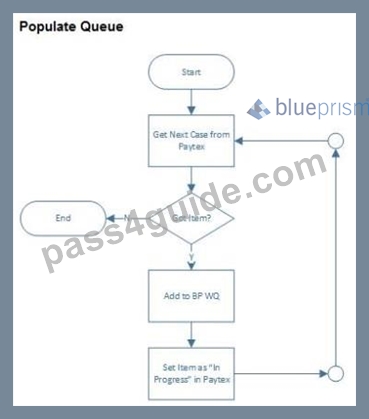
Which of the following are correct? (select 3 responses).
- A. The process should not be automated as it uses a third party web application.
- B. There is a risk that a payment can be orphaned.
- C. The process should not be designed to use a Blue Prism Work Queue but use Paytex as the work queue.
- D. The solution exposes sensitive personal information
- E. The process will not scale i.e. you cannot run multiple instances at the same time
- F. There is a risk that a payment can be duplicated.
Answer: C,D,E
NEW QUESTION 32
Consider the following steps for a theoretical manual process
* Check in input folder for any new files.
* If there are no files check again later as files can arrive anytime, and there is no limit to the number of files that may come.
* Open the next available file.
* Take the first case
* Start System X and find the case details.
* If the case can't be found, move to the next one.
* After finding the case in System X. fetch additional case details from System Y.
* Again if the case can't be found, move to the next one
* Analyse all the data to see if System Z should be updated.
* If the data does not meet the requirements, add notes indicating this to Systems X and Y and move to the next case
* If the data does meet the requirements, update the case in System Z
* Add notes to Systems X and Y and move to the next case.
* At the end of the file, go back and look for another
* Stop checking for new files at 16:00 and finish any remaining cases.
* When all work is complete create a report of the day's exception cases.
* Close down Systems X, Y and Z.
If the volume of incoming cases is such that 1 Resource PC can easily handle the workload, which of the following steps for an automated solution should be part of the 'Preparation' phase of an automated process?
- A. Check input folder, wait for files
- B. Check input folder, wart for files, read file and load queue, log into applications.
- C. Log into applications
- D. Check input folder, wart for files, read file and load queue
Answer: B
NEW QUESTION 33
If a solution is to make use of a queue with Maximum Attempts greater than 1, what should the designer put in place? (Choose two.)
- A. A decision whether or not to use an available retry item before marking an item complete.
- B. A decision whether or not to use an available retry item after marking an item as an exception.
- C. Logic to ensure that the next attempt to work a case is executed on a different machine from the previous attempt.
- D. Logic to identify the progress made by previous attempts to work a case.
- E. Logic to ensure that the next attempt to work a case is executed on the same machine as the previous attempt.
Answer: A,E
NEW QUESTION 34
A retail bank has promoted 2 Blue Prism processes to production
1. Email poller
2 Customer onboarding
3. Direct Debit Cancellations
One instance of the email poller process will run 24/7 feeding work queues for the other two processes.
Three instances of the Customer onboarding process will run between 6am and 11 pm each day on three separate VMs One instance of the Direct Debit Cancellations process will run between 6am and 4pm each day on the same VM as the Email poller process What is the maximum number of Blue Prism licenses that will be consumed each day?
- A. 0
- B. 1
- C. 2
- D. 3
Answer: C
NEW QUESTION 35
A process definition document has been produced for a process that interfaces with two applications FirstApp and Customer Information (CI) The process requirement is to perform data extraction from FirstApp before performing a number of steps in the CI application.
It is estimated that to perform the daily case volume within SLA's will require 10 robots Average license time is approximately 10 minutes, with the FirstApp steps requiring only 1 minute to perform.
The client has a limited number of licences for the FirstApp application and is reluctant to use 10 of these licenses to automate the process.
Which of the below is a valid design option for the project?
- A. Automate the end to end process using a single Blue Prism process which will be run on 10 robots
- B. Automate the end to end process using two Blue Prism processes. Process 1 will perform the FirstApp tasks. Process 2 will perform the CI tasks Data will be passed from Process 1 to Process 2 via a Blue Prism Work Queue Process 1 will run on a single robot, with Process 2 running on 9 robots.
- C. Automate the end to end process using a single Blue Prism process which will only be run on a single robot.
- D. Automate the end to end process using two Blue Prism processes Process 1 will perform the FirstApp tasks. Process 2 will perform the CI tasks. Data will be passed from Process 1 to Process 2 via a spreadsheet. Process 1 will run on a single robot, with Process 2 running on 9 robots.
Answer: B
NEW QUESTION 36
Imagine a DR scenario where the main Production database goes down one afternoon. All processes use work queues and all new work is loaded first thing each morning. The database is backed up regularly but not in real time, so the restored back up will be slightly out of date, say by 1 hour. If the backup was restored, and processes were restarted what would be the effect? (select 2 responses)
- A. The work queue would automatically ensure no cases is duplicated.
- B. The processes would resume with the queue item being worked at the time of the incident
- C. The queue item being worked at the time of the incident would need to be manually marked as an exception.
- D. The queue item being worked at the time of the incident would be automatically marked as an exception.
- E. The processes would resume with the next available queue item
Answer: D,E
NEW QUESTION 37
A process definition document has been produced for a process that interfaces with two applications: FirstApp and Customer Information (CI). The process requirement is to perform data extraction from FirstApp before performing a number of steps in the CI application.
It is estimated that to perform the daily case volume within SLA's will require 10 robots. Average case time is approximately 10 minutes, with the FirstApp steps requiring only 1 minute to perform.
The client has a limited number of licenses for the FirstApp application and is reluctant to use 10 of these licenses to automate the process.
Which of the below is a valid design option for the project?
- A. Automate the end to end process using single Blue Prism process which will only be run on a single robot.
- B. Automate the end to end process using two Blue Prism processes. Process 1 will perform the FirstApp tasks, Process 2 will perform the CI tasks. Data will be passed from Process 1 to Process 2 via a spreadsheet. Process 1 will run on a single robot, with Process 2 running on 9 robots.
- C. Automate the end to end process using two Blue Prism processes. Process 1 will perform the FirstApp tasks, Process 2 will perform the CI tasks. Data will be passed from Process 1 to Process 2 via a Blue Prism Work Queue. Process 1 will run on a single robot, with Process 2 running on 9 robots.
- D. Automate the end to end process using single Blue Prism process which will be run on 10 robots.
Answer: B
NEW QUESTION 38
......
Get to the Top with ASD01 Practice Exam Questions: https://torrentvce.pass4guide.com/ASD01-dumps-questions.html