


JN0-650 Practice Juniper Verified Answers - Pass Your Exams For Sure! [2026]
Valid Way To Pass JNCIS-ENT's JN0-650 Exam
Juniper JN0-650 Exam Syllabus Topics:
| Topic | Details |
|---|---|
| Topic 1 |
|
| Topic 2 |
|
| Topic 3 |
|
| Topic 4 |
|
| Topic 5 |
|
| Topic 6 |
|
NEW QUESTION # 23
You have configured 802.1x access control.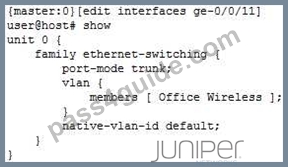
Which statement is true when the RADIUS server is unreachable by the switch?
- A. The switch will terminate all existing connections are require re-authentication.
- B. The switch will allow all new attempts to authenticate.
- C. The switch will deny all traffic through the port.
- D. The switch will place all new connections in the wireless VLAN.
Answer: C
NEW QUESTION # 24
Which two statements are true regarding BGP communities? (Choose two.)
- A. BGP communities cannot be transmitted across AS borders.
- B. BGP communities are not part of the default route selection process.
- C. BGP communities are part of the default route selection process.
- D. BGP communities can be transmitted across AS borders.
Answer: B,D
NEW QUESTION # 25
Exhibit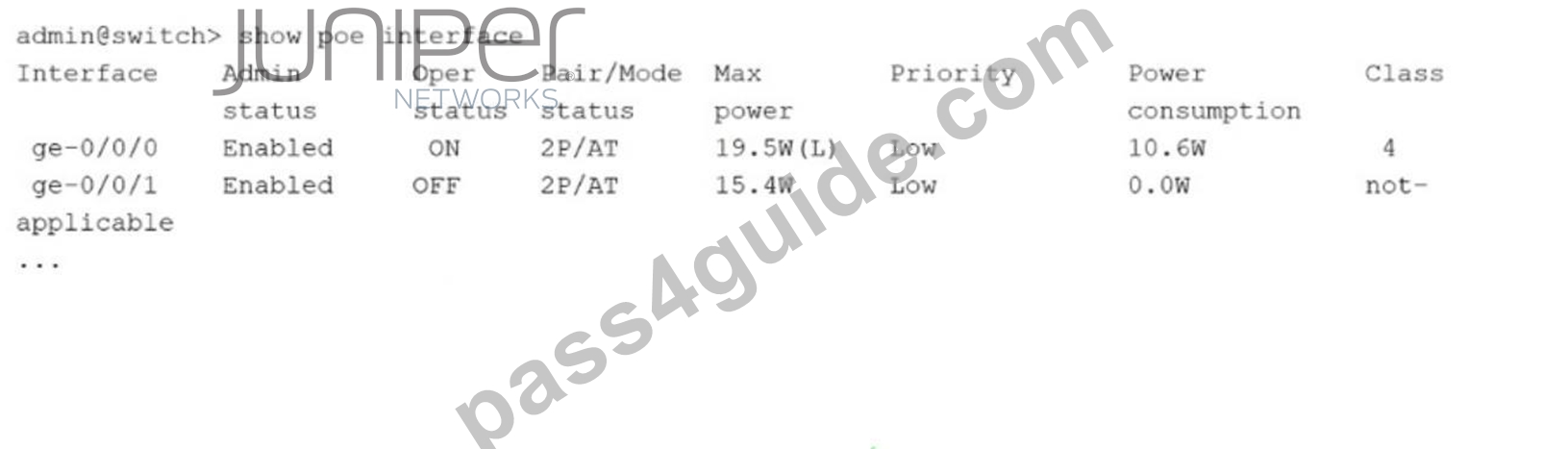
You are deploying a new campus switching environment using various EX Series switch models. The devices attached to one of the new EX Senes switches include IP phones, loT devices, and wireless access points (APs) requiring power over Ethernet (PoE) with varying power requirements. A sample output from one of these switches is shown in the exhibit.
In this scenario, which two statements are correct? (Choose two.)
- A. The switch is capable of supplying up to 60 W of power to attached PoE devices.
- B. The switch is capable of supplying up to 30 W of power to attached PoE devices.
- C. Port ge-0/0/0 is enabled and has dynamically learned maximum power and device class designations.
- D. Port ge-0/0/0 is enabled and has its maximum power and device class designations statically configured.
Answer: B,C
Explanation:
The exhibit shows the output of the show poe interface command on a Juniper switch.
* VTEP Power Capabilities (Statement D): The exhibit shows the Pair/Mode as 2P/AT, which refers to the IEEE 802.3at (PoE+) standard. Under this standard, a switch can supply up to 30 W of power per port to attached devices (PDs). * Dynamic Learning (Statement C): Looking at the Max power column for port ge-0/0/0, it shows 19.5W(L). The (L) indicator signifies that the power has been dynamically learned (negotiated) via LLDP or hardware classification, rather than being statically configured by an administrator. Additionally, it has identified the device as Class 4, which is a standard dynamic classification for PoE+ devices.
* Why others are incorrect: Statement A (60 W) refers to the 802.3bt (PoE++) standard, which is not indicated here. Statement B is incorrect because the "(L)" confirms the configuration is not static.
NEW QUESTION # 26
You recently implemented the configuration shown in the exhibit.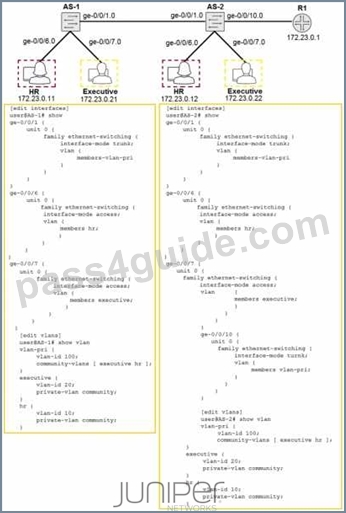
After committing these changes, the community devices connected to AS-1 are not able to communicate with the appropriate community devices connected to AS-2. What must be done to allow these community devices to communicate?
- A. You must configure the ge-0/0/10 interface on AS-1 as the inter-switch link
- B. You must configure an isolation VLAN ID under the vlan-pri VLAN on both switches
- C. You must configure the ge-0/0/1 interface on both switches the inter-switch links
- D. You must configure an isolation VLAN ID under the vlan-pri vlan on the AS-2 switch
- E. You must configure to allow the ge-0/0/1 interface on AS-1 as the inter-switch
Answer: C
NEW QUESTION # 27
In Junos, what does the command 'set protocols bgp group IBGP type internal' accomplish?
- A. It disables the BGP group.
- B. It sets up an external BGP group.
- C. It configures a redistribution policy for the BGP group.
- D. It configures an iBGP group with internal peers.
Answer: D
NEW QUESTION # 28
You have scheduled maintenance operations for one of the devices in your OSPF network.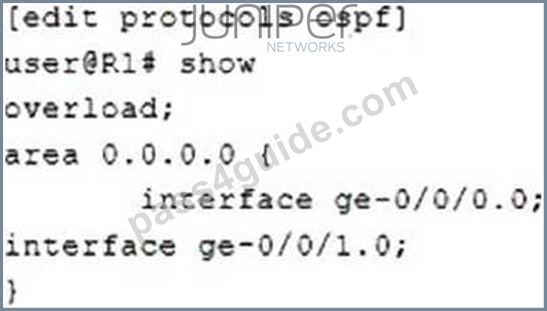
Referring to the exhibit, which three statements are correct? (Choose three.)
- A. R1 does not participate in OSPF routing.
- B. The metrics for all transit interfaces on R1 is set to the maximum value of 65,535.
- C. R1 participates in OSPF routing but does not send or receive transit traffic.
- D. R1 does not send or receive transit traffic during the maintenance window even if no alternative paths exist to the given destination.
- E. Any traffic destined for networks that terminate on R1 will still be forwarded to R1.
Answer: B,C,E
NEW QUESTION # 29
How is MSDP used in conjunction with PIM-SM?
- A. To exchange multicast source information between PIM-SM domains
- B. To enhance multicast traffic encryption
- C. To optimize the multicast routing table size
- D. To replace the need for an RP within a PIM-SM domain
Answer: A
NEW QUESTION # 30
Referring to Spanning Tree Protocol, what is the function of BPDU protection?
- A. It rate limits the BPDUs entering the device to prevent flooding.
- B. It adds a checksum to the BPDUs for authentication.
- C. It places the root port into blocking state if BPDUs are detected on the port.
- D. It places an edge port into blocking state if BPDUs are detected on the port.
Answer: D
NEW QUESTION # 31
You have two multicast receivers connected to the same VLAN. You notice that the switch that they are connected to is forwarding multicast traffic out of all the ports in the same VLAN, instead of just the two ports for the connected multicast receivers In this scenario, what would you configure to optimize multicast forwarding?
- A. IRB interface
- B. promiscuous mode
- C. spanning tree
- D. IGMP snooping
Answer: D
Explanation:
In a standard Layer 2 switch environment without specific multicast optimizations, multicast traffic is treated similarly to broadcast traffic and isflooded out of all portswithin a VLAN (except the port where it was received). This is inefficient as it consumes unnecessary bandwidth on ports where no receivers are present.
To optimize this,IGMP Snoopingis the standard solution.
* How it works:The switch "snoops" or monitors IGMP (Internet Group Management Protocol) messages between hosts and routers.
* Result:When a receiver sends an IGMP Membership Report (Join) for a specific multicast group, the switch records which port that request came from. It then builds a Layer 2 multicast forwarding table so that traffic for that group isonly forwardedto the specific ports that have active listeners.
* Junos OS 24.4 Configuration:On modern Juniper switches, you enable this globally or per VLAN using the set protocols igmp-snooping vlan <vlan-name> command.
Option A (Promiscuous mode)is used for monitoring or specific security configurations (like Private VLANs) and would not limit multicast flooding.Option B (Spanning Tree)manages loop prevention and does not differentiate between traffic types for forwarding optimization.Option D (IRB interface)is used for Layer 3 routing between VLANs but does not inherently provide Layer 2 multicast optimization within a single VLAN.
NEW QUESTION # 32
What type of routing policy would be used in Junos to affect the export of routes to BGP peers?
- A. Rib-group policy
- B. Import policy
- C. Firewall filter
- D. Export policy
Answer: D
NEW QUESTION # 33
When configuring multicast routing policies, what is a common action?
- A. To define which multicast sources to accept or deny
- B. To increase the priority of multicast over unicast traffic
- C. To set the administrative distance of multicast routes
- D. To convert multicast traffic to unicast for easier routing
Answer: A
NEW QUESTION # 34
Your OSPF network consists of a mix of 1GbE and 10GbE interfaces. By default, all interfaces have the same cost in your OSPF network. You are asked to ensure that the 10GbE interfaces are more preferred when available In this scenario, which two statements would accomplish this behavior? (Choose two.)
- A. You should define the reference bandwidth as 1G. which will assign the 1GbE interfaces a higher cost.
- B. You should manually assign the interface metric for each 1GbE interface to be higher than the 10GbE interfaces in your OSPF network.
- C. You should define the reference bandwidth as 10G. which will assign the 1GbE interfaces a higher cost
- D. You should manually assign the interface metric for each 10GbE interface to be higher than the 1GbE interfaces in your OSPF network.
Answer: B,C
Explanation:
OSPF determines the best path to a destination by calculating the metric (cost) of each link. By default, Junos OS uses a reference bandwidth of 100 Mbps to calculate this cost using the formula: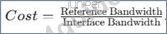
When the reference bandwidth is left at the default 100 Mbps, any interface with a speed of 100 Mbps or higher (including 1 GbE and 10 GbE) is assigned a cost of 1 because the minimum OSPF cost is 1. This results in equal-cost paths, preventing the router from preferring the faster 10 GbE link.
To ensure 10 GbE interfaces are preferred, you must create a cost differential:
* Option A (Reference Bandwidth): By increasing the reference bandwidth to 10G (or higher), the calculation changes. For a 10 GbE link, the cost becomes $10,000 / 10,000 = 1$. For a 1 GbE link, the cost becomes $10,000 / 1,000 = 10$. Since OSPF prefers the path with the lowest cumulative cost, the
10 GbE link is now preferred.
* Option D (Manual Metric): You can manually override the automatic cost calculation by assigning a higher metric specifically to the 1 GbE interfaces. If a 1 GbE interface is manually set to a cost of 50 and the 10 GbE interface remains at 1 (or is set to a lower value), the router will prioritize the 10 GbE path.
Option B is incorrect because a higher metric makes a path less preferred. Option C is incorrect because a
1G reference bandwidth would still result in both 1 GbE and 10 GbE interfaces having a cost of 1.
NEW QUESTION # 35
You enable the Multiple VLAN Registration Protocol (MVRP) to automate the creation and management of virtual LANs.
Which statement is correct in this scenario?
- A. The forbidden mode does not register or declare VLANs.
- B. MVRP works with RSTP and VSTP.
- C. Timers dictate when link state changes are propagated.
- D. When enabled, MVRP affects all interfaces.
Answer: A
NEW QUESTION # 36
Which Junos operational command is used to display the IS-IS adjacency table?
- A. show isis database
- B. show isis adjacency
- C. show isis route
- D. show isis spf
Answer: B
NEW QUESTION # 37
What is the significance of the rendezvous point in PIM sparse-mode multicast routing?
- A. It is used to optimize the multicast path to each receiver
- B. It acts as a central controller for all multicast streams in the network
- C. It serves as the backup mechanism for multicast stream delivery
- D. It is the initial meeting place for receivers and senders of multicast data
Answer: D
NEW QUESTION # 38
......
Juniper JN0-650 Pre-Exam Practice Tests | Pass4guide: https://torrentvce.pass4guide.com/JN0-650-dumps-questions.html